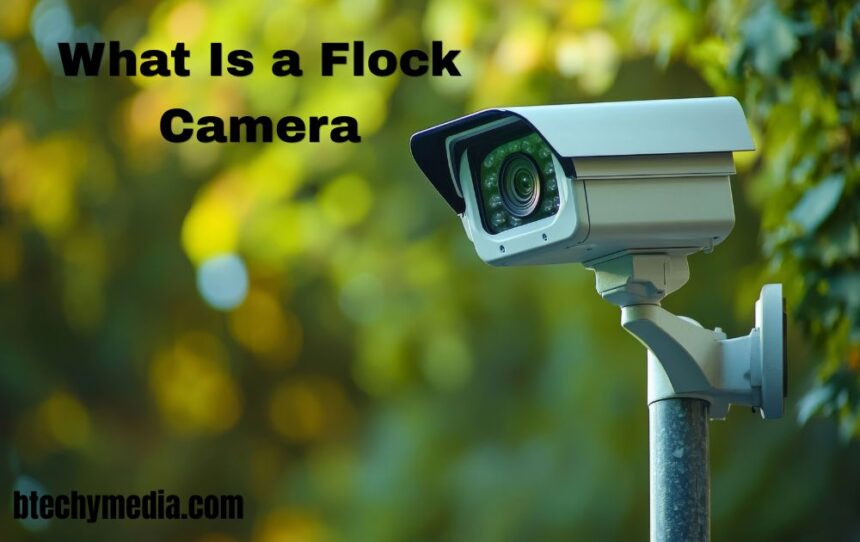
A Flock camera is a specialized license plate recognition camera designed to capture information about vehicles passing through a particular location. Unlike a traditional security camera that records broad video footage, a Flock camera focuses mainly on vehicles, license plates, and visible vehicle characteristics. Flock Safety says its cameras can capture details such as license plate information, vehicle make, model, color, and other visible features, while its LPR system does not use facial recognition. These cameras are commonly used in neighborhoods, businesses, parking areas, and law-enforcement environments to provide searchable vehicle evidence. Understanding how a Flock camera works can help residents and property owners better understand both its security benefits and privacy considerations.
What Is a Flock Camera?
A Flock camera is an automated license plate reader (ALPR) designed to identify and record passing vehicles. The camera captures point-in-time images and uses technology to turn visible vehicle information into searchable data. Flock describes its system as vehicle-focused rather than a general-purpose surveillance system, meaning its primary purpose is to collect information that can help distinguish one vehicle from another. This makes it different from a regular CCTV camera, which may continuously record people, buildings, and surrounding activity. Flock cameras are often positioned at entrances, exits, roads, and other areas where vehicles naturally pass.
How Does a Flock Camera Work?
When a vehicle passes within a Flock camera’s viewing area, the system captures images of the vehicle and license plate. Its software can then process information such as the plate characters, vehicle type, make, model, color, time, and camera location. Flock says its LPR technology converts vehicle and license plate images into computer-readable information so authorized users can search the data more efficiently. Instead of requiring someone to watch hours of video, an authorized user can search available vehicle information using specific details related to an incident.
What Information Does a Flock Camera Capture?
Flock’s current privacy information says its ALPR system collects license plate images, vehicle characteristics, date and time stamps, and camera location identifiers. Vehicle characteristics may include details such as make, model, color, body type, and other visible features that can help distinguish one vehicle from another. The system is designed to focus on information associated with the vehicle rather than collecting biometric information about people. Flock states that its LPR system does not collect facial recognition data or driver information through the ALPR system.
Flock Camera vs. Traditional Security Camera
The main difference between a Flock camera and a traditional security camera is what each system is designed to capture and organize. A conventional security camera generally records video showing people, vehicles, buildings, and activities in a wider area. A Flock LPR camera is designed specifically around vehicle identification and license plate information, producing searchable vehicle records rather than simply providing a long video recording. Flock itself explains that traditional security cameras focus on general video and context, while its LPR cameras use still images to focus on vehicles and license plates.
| Feature | Flock Camera | Traditional Security Camera |
| Primary purpose | Vehicle and license plate recognition | General surveillance |
| License plate data | Yes | Usually requires manual review |
| Vehicle characteristics | Yes | May require manual inspection |
| Facial recognition | No for Flock LPR | Depends on system |
| Searchable vehicle information | Yes | Usually limited |
| Typical locations | Roads, entrances, neighborhoods | Buildings, homes, businesses |
Why Are Flock Cameras Installed in Neighborhoods?
Many communities install Flock cameras near entrances and exits because these locations provide useful opportunities to capture vehicles entering or leaving an area. If a burglary, vehicle theft, or other incident occurs, authorized users may be able to search the system for vehicles matching a particular description or license plate. Flock also offers neighborhood features such as a Safe List that can identify registered resident vehicles within the community’s system. The purpose is generally to create another source of vehicle evidence rather than replace other security measures such as home cameras, alarms, lighting, or physical security.
How Do Flock Cameras Help With Investigations?
Flock cameras can provide investigators with a searchable record of vehicle activity around a particular location. For example, if investigators know that a certain type of vehicle was present near an incident at a specific time, available vehicle characteristics can help narrow the search. Flock says users can search information such as vehicle color, type, license plate number, and time window through its platform. This can make vehicle evidence easier to locate than manually reviewing large amounts of ordinary security footage. However, a camera record is generally one piece of evidence and does not by itself establish who was driving the vehicle or what the person was doing.
Can Flock Cameras Detect Stolen Vehicles?
Yes, Flock systems can support stolen-vehicle alerts when a detected vehicle matches information on an authorized hot list. Flock says its cameras can integrate with the National Crime Information Center (NCIC) for certain wanted-vehicle alerts, allowing local law enforcement to receive an alert when a matching vehicle is detected. This type of notification can give authorities an opportunity to investigate a vehicle while it is still in the area. The alert itself should be understood as an investigative lead rather than automatic proof of criminal activity.
Can Flock Cameras Identify People?
A Flock LPR camera is designed to identify vehicles rather than people. Flock’s current privacy materials state that its ALPR system does not collect biometric data, driver information, or facial-recognition data. This means the camera is not designed to recognize someone simply by their face. However, vehicle information can still be useful during an investigation because an authorized organization may have additional information outside the camera system that can help connect a vehicle record with other evidence.
Do Flock Cameras Use Facial Recognition?
No. According to Flock Safety’s current materials, its LPR cameras do not use facial recognition. The system searches based on vehicle details rather than human facial characteristics. This distinction is important because license plate recognition and facial recognition are two different technologies. A Flock LPR system can help identify a vehicle’s visible characteristics, but it is not designed to scan a person’s face and automatically determine their identity.
How Long Does Flock Store Camera Data?
Flock’s current policies state that the standard LPR retention period is seven days, although the actual period can vary when local law, customer agreements, or specific policies require something different. Flock has also introduced an Evidence Mode intended to preserve specific data associated with active investigations under applicable policies. This means it is important to distinguish the ordinary retention period from information that has been appropriately preserved for an investigation. Anyone asking about a particular camera should check the policy established by the organization operating that camera.
Who Can Access Flock Camera Data?
Access to Flock data is controlled through the organization that operates the system and its user permissions. Flock says customers retain ownership and control of their data, while access is restricted to approved users with role-based permissions. The company’s current privacy information also says that searches are recorded and can be reviewed. This creates an audit trail around system use rather than allowing anonymous access. Exact access rules can vary between law-enforcement agencies, neighborhoods, businesses, and other customers.
Are Flock Cameras Always Recording?
Flock LPR cameras are designed to operate continuously as vehicle-detection systems, but they are not the same as a traditional camera that continuously stores ordinary video of everything happening around it. Flock describes its LPR technology as capturing point-in-time images of vehicles in public view and converting those images into searchable vehicle information. The distinction matters because people sometimes assume that an LPR camera creates a complete video record of an entire street. Its primary function is instead to document vehicle events that occur within the camera’s field of view.
Where Are Flock Cameras Commonly Used?
Flock cameras can be found in different environments where vehicle information may be useful for security or investigations. Neighborhoods may place them at entrances, businesses can use them around property access points, and law-enforcement agencies may deploy them at selected roadway locations. Flock describes its LPR products as being used across communities and public-safety environments. The placement is important because the camera’s effectiveness depends on vehicles passing through an area where the license plate and other relevant characteristics can be captured clearly.
What Are the Benefits of Flock Cameras?
Flock cameras can make vehicle information easier to search and use when an incident occurs. Instead of manually looking through hours of conventional footage, an authorized user may search by information such as a license plate, vehicle type, color, or time period. Flock says its platform is designed to organize vehicle information and provide alerts for certain authorized hot-list matches. Common benefits include:
- Searchable vehicle evidence
- License plate recognition
- Vehicle characteristic searches
- Automated alerts for certain matches
- Support for criminal investigations
- Auditable system access
What Are the Limitations of Flock Cameras?
Flock cameras have limitations just like other surveillance technologies. Their performance can depend on lighting, weather, camera placement, traffic conditions, license plate visibility, and the quality of the captured image. Flock’s own LPR policy acknowledges that license plate translation can occasionally be incomplete or inaccurate and instructs users to confirm computer-generated information before taking action based on an alert or search. A Flock camera also does not provide complete information about an incident, because it focuses primarily on vehicles rather than the entire surrounding environment. For that reason, traditional security footage and other forms of evidence can still be important.
Are Flock Cameras Accurate?
Flock says its LPR systems have a high rate of accuracy and that machine-learning technology is used to improve recognition. Its policy also acknowledges that occasional inaccurate or incomplete plate translations can occur. Factors such as weather, poor visibility, unusual license plates, obstructions, and camera positioning can affect recognition quality. For responsible use, an automated camera result should be treated as information that may require confirmation rather than as an unquestionable fact. This is especially important when an alert could lead to further investigation or enforcement activity.
What Are the Privacy Concerns With Flock Cameras?
Privacy is an important part of any discussion about license plate recognition. Although Flock says its LPR cameras do not use facial recognition, the system can still create records containing a vehicle’s plate, location, and time. Questions can therefore arise about how long information is retained, who can search it, when it can be shared, and what oversight applies. Flock says customers control their data and that access and searches are subject to controls and auditing. Local laws and policies can also affect how the technology is operated.
Flock Camera vs. ALPR: What Is the Difference?
ALPR stands for Automatic License Plate Recognition and describes a broader category of technology. Flock Safety is a company that provides ALPR technology along with software and other public-safety products. Therefore, a Flock LPR camera is one example of an ALPR system, but other companies also produce license plate recognition equipment. Different systems can have different features, accuracy standards, retention periods, integrations, and access policies. When comparing them, it is useful to look beyond the camera itself and examine how the complete system handles data, searches, security, and privacy.
How Much Does a Flock Camera Cost?
The cost of a Flock camera system can depend on the customer, number of cameras, deployment requirements, subscription terms, and included services. Flock’s FAQ describes its offering as a service that can include installation, maintenance, hosting, cellular connectivity, and software updates. Because pricing can vary by deployment, there is not one universal price that applies to every neighborhood, business, or agency. Organizations considering the technology should request current pricing and examine the complete agreement, including installation, maintenance, retention, support, and data-management terms.
Is a Flock Camera the Same as a Home Security Camera?
No, a Flock camera and a home security camera serve different primary purposes. A home security camera may record a broad view of a doorway, yard, driveway, or room and can show people, animals, vehicles, and other activity. A Flock LPR camera is designed specifically around vehicle and license plate information. Flock itself distinguishes LPR cameras from traditional security cameras by explaining that LPR systems focus on vehicles and capture still images intended to provide clear license plate information. A community may therefore use both technologies because they provide different types of information.
Conclusion
So, what is a Flock camera? It is a specialized license plate recognition system designed to capture and organize information about vehicles passing through a monitored location. It can record license plate details, vehicle characteristics, time, and camera location, while Flock says its LPR system does not use facial recognition. The technology can support investigations and provide alerts for certain authorized vehicle matches, but it also brings important questions about privacy, retention, access, and oversight. Understanding both the capabilities and the policies surrounding a particular installation provides a clearer picture of how the technology is being used.
FAQs About Flock Cameras
What is a Flock camera used for?
A Flock camera is mainly used to capture license plates and vehicle characteristics that can support security and investigative work.
Can Flock cameras see inside a vehicle?
Flock LPR cameras are designed to focus on vehicles and license plates rather than identifying people inside vehicles.
Does Flock use facial recognition?
No, Flock states that its LPR technology does not use facial recognition.
Can Flock cameras detect stolen cars?
Yes, authorized systems can provide alerts when detected vehicles match certain stolen-vehicle or other authorized hot-list information.
How long does Flock keep license plate data?
Flock’s current standard LPR retention period is seven days, although local laws and customer policies can establish different periods.
Can Flock camera data be shared with police?
Sharing depends on the customer’s permissions, agreements, and applicable policies; Flock says customers control their data and sharing.